The return of great power relations: a world of bounded orders – Part 2
April 22, 2026
In the second part of his piece for the Foreign Policy Rethink series, Geoff Raby examines how China is constructing a competing global order and reshaping the institutions that underpin international relations.
In 2019, leading realist international relations theorist, John Mearsheimer, suggested that great power rivalry in a multipolar world might resolve into a pattern of ‘bounded orders’. He posited that in such a world, stability might be achieved with states loosely coalescing around two or more leading states with whom they share important affinities.
He was careful, however, to argue that these would not be mutually exclusive blocs which would inevitably lead to conflict between them as security could only be achieved by the defeat of the other. When he initially suggested bounded orders as a theoretical proposition, as an offensive realist he also dismissed the idea quickly and returned to his main proposition that war between great powers was inevitable. At the time, he also did not identify the US and China as leaders of their respective orders. Subsequently, he has done so.
A bounded order is where a group of countries align with a major power with whom they share values and broadly similar or compatible systems of political and social organisation. Importantly, there will be a set of trans-national institutions, rules and norms that underpin respective economic and investment dependencies.
Unlike mutually exclusive ‘blocs’, states can and will need to cooperate across orders on some issues affecting the global commons. They also are different to more traditional spheres of influence which are defined primarily by their spatial relationship with the dominant power. Accordingly, they are not restricted to contiguous territories, can be global, and are defined by their mutually supported trans-national institutions.
Moreover, states may overlap depending on the degree of convergence with the dominant power’s norms, values and form of political and social organisation. Before the election of Trump, it would have been reasonable to suggest that the more democratic and liberal a state was the more closely it would align itself with US leadership. That may be less so now.
Following the events of 3 January 2026, many middle powers may begin questioning the extent of their alignment with US values and approaches to international relations. Previously, China’s order may not have been a comfortable place for them, but the institutional arrangements China has been constructing may now start to look more attractive.
China’s institutional entrepreneurship
China been constructing its order in front of our eyes for over two decades. In the west, there was a myopic, ‘nothing to see here’ attitude as China set about deliberately crafting the institutional arrangements to underpin and give coherence to its order. It is now no longer possible for lesser powers to look away.
Together with its deep trade and investment flows, China has engaged in a systematic, deliberate process of trans-national institution building. Jointly with Russia, from the early years of this millennium, it led the institutionalisation of Eurasian multinational security cooperation with the Shanghai Cooperation Organisation (SCO).
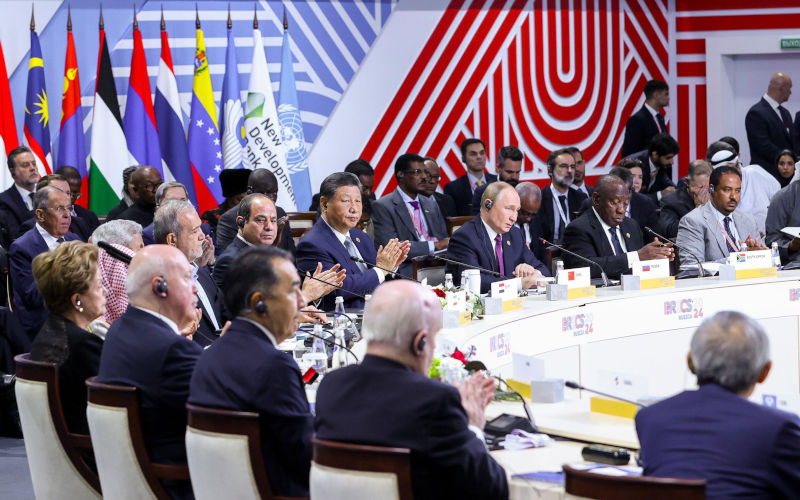
Similarly, while Russia initiated early cooperation among several emerging economies as a forerunner of the BRICS, China has been the main driving force. The BRICS Bank, renamed as the New Development Bank, is headquartered in Shanghai. ‘De-dollarisation’ of international payment settlements has emerged as a priority objective for the BRICS, attracting a great deal of international interest, especially among the Global South.
The highest profile initiative has been the Belt and Road (BRI) which was originally intended to re-cycle China’s massive foreign reserves and excess infrastructure construction capacity. It has since become the principal means by which China orders its foreign trade and investment priorities. The BRI has been pursued on a hitherto unimaginable scale, but it has also been controversial with accusations of ‘debt-trap’ diplomacy, waste and corruption. China also established the Asia Infrastructure Investment Bank (AIIB) to complement the BRI.
China holds regional neighbours close to itself through a delta of free-trade agreements. The first was with ASEAN in 2003 which, in 2025, was renewed, expanding into new areas, including digital trade and AI. Seeking to take geostrategic advantage from the weakening of Russia’s position in Central Asia post the invasion of Ukraine, China has struck several bilateral security and military arrangements with the Stans, previously the almost exclusive preserve of Russia. In 2023, China convened the first summit of the C+C5 group (China plus the five Stans), with a permanent secretariat established in Xi’an intended to coordinate security issues between them. Russia was excluded.
The international system, therefore, now involves heightened competition between multilateral and a host of plurilateral and mini-lateral institutions. Increasingly, these are aligned with either the US-led or China-led orders.
Whither multilateralism?
In this world of bounded orders, legacy multilateral institutions associated with the UN and Bretton Woods will still play a role in addressing concerns over the global commons. Climate change and arms control are two obvious areas. Global rules on AI, space and the polar regions might be others. Efforts are also continuing in the WTO to maintain some continuity in global trade rules, despite the US’ open disregard.
The positions states take in multilateral institutions, however, will be increasingly shaped by their respective orders. China still sees advantages for itself in certain parts of the multilateral system as a means of simultaneously advancing its interest while deflecting criticism of its behaviour. China remains a significant participant in the UN system: a major funder of peace keeping and holds many senior positions across the UN’s various organisations. China is well positioned to continue to align its order with its objectives in multilateral institutions, the principal features of which are to preserve territorial integrity and to emphasise economic development over the west’s liberal, humanist concerns.
In 2024, a report by the Washington based Centre for Strategic and International Studies found that the Global South was increasingly aligning with China in UN bodies, while US influence continued to wane. In the year since Trump moved back to the White House, these trends have become more pronounced. The abrupt abolition of USAID, for example, has been a major factor in weakening the US’ actual and moral authority.
China has successfully sought positions as head of UN specialised agencies to align its activities with BRI objectives and to continue to restrict Taiwan’s involvement in such organisations. In 2025, China held four out of 15 specialised agency heads and nine deputy positions. The African group, with 28 per cent of UN votes, has been a key to expanding China’s representation and influence in the UN. African states have also been substantial BRI participants and beneficiaries.
The future relevance of multilateral institutions is probably more challenged today than at any time since the end of the Second World War. Nevertheless, middle and small powers will continue to look towards multilateralism to provide some restraint on great powers. But in important areas, such as trade and arms control, the multilateral system is in secular decline in terms of its capacity to influence the behaviour of powerful states.
A shift is underway from a hegemonic multilateralism to one which is pluralistic, contested and hence negotiated. This is well advanced within the trade field, where the WTO has been largely marginalised, replaced by a plethora of bilateral, regional and mini-lateral arrangements which set norms and make rules.
China senses great opportunity at this time of realignment of the international system. As Xi Jinping told Vladimir Putin in March 2023: “Right now, there are changes in the world – the likes we have not seen for 100 years – and we are the ones driving those changes together”.
Part 2 of this 4-Part series is republished from Global Neighbours.org, 13 February, 2026
The views expressed in this article may or may not reflect those of Pearls and Irritations.
